Is MSFT's Bottom In? — Structural Read, April 14, 2026
MSFT is at a critical decision zone: price testing the $381 flip level after a sharp 3% bounce off the March low at $356. FinTwit is calling the bottom. The chart is calling compression. Three timeframes — daily structure, the staircase to $500, and the 200-week analog to January 2023 — all answer the same question.
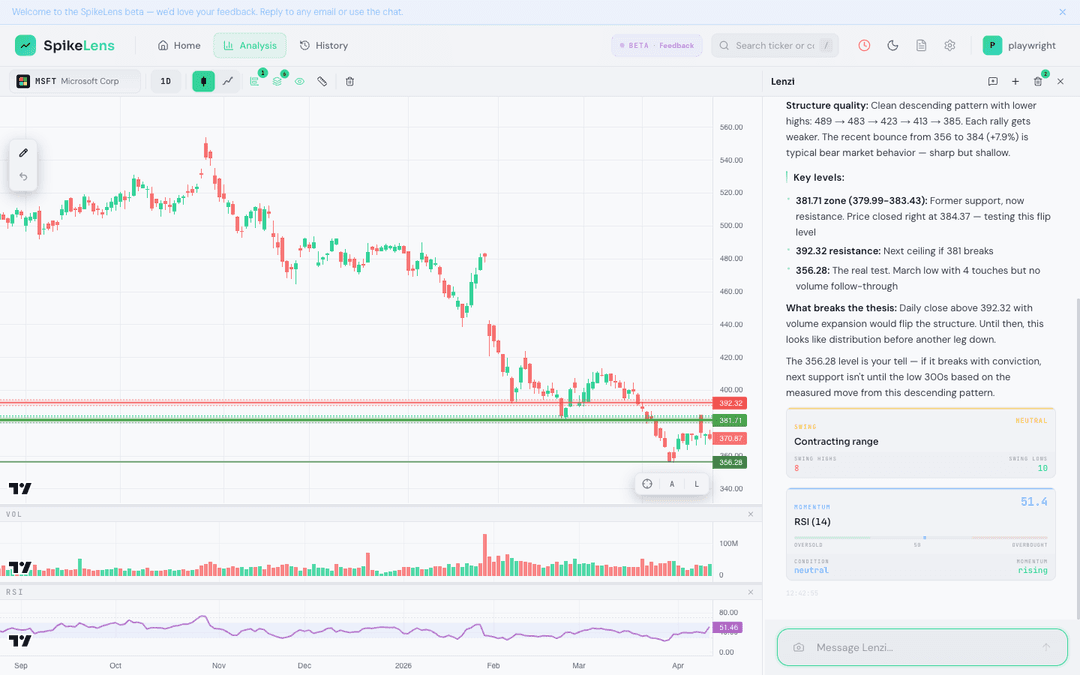
Market Summary
Current price: near $384 Prior week close: $371 (Apr 13) Structure: Clean descending pattern — lower highs $489 → $483 → $423 → $413 → $385 RSI: 51.4 (daily, neutral, momentum rising) Weekly RSI: 36.8 (neutral) Weekly volume: 35M vs 147M 20-week average (0.24× relative volume)
The Detail
### Read 1 — Daily structure says "compression, not bottom"
The shape of a bottom in structural terms requires evidence that buyers are taking control: expanding retracements, higher lows, and a confirmed breakout above a prior pivot. MSFT has none of those. What it has is 4 bear impulses averaging −13.2% each vs weak bounces averaging only +6.8%. That's a 1.9:1 impulse ratio — sellers are still doing the heavy lifting in both magnitude and frequency.
Price right now is at the $381.71 zone — a level that was support through February before failing in early March. When a support level fails and price bounces back to it, that's a bear flip: former support becomes fresh resistance. Testing it is standard behavior. Reclaiming it (daily close above $392.32 with expanding volume) is what would change the read.
### Read 2 — The staircase to $500 is six resistance zones tall
Traders calling for "$500 next" need to account for six overhead zones between current price and $500:
- $381–$384 (immediate overhead — where we are)
- $392–$394 (February breakdown level, now resistance)
- $413–$416 (March high, needs volume expansion)
- $438–$441 (January crash low, major test)
- $468–$471 (December support turned resistance)
- $483–$493 (the big one — 12 touches, massive overhead supply)
That's roughly 34% of upside work just to reach the first *major* supply zone. Each level represents sellers who got trapped on the way down. The path isn't a straight line — it's a grinding campaign, one level at a time, with volume confirmation required at every flip.
### Read 3 — The 200-week analog to January 2023 is a stretch
A popular bull argument: "MSFT touched the 200-week moving average in Jan 2023 and ran 60% in 6 months — history rhymes." But the conditions don't match.
January 2023 setup: - Hit 200 WMA around $226 with RSI extreme oversold (~25–30) - Volume heavy — averaging 144M vs current 35M (4× current participation) - Price bounced immediately and held above the MA - Market was coming off a brutal 2022 crash — deeply oversold broad-market backdrop
April 2026 setup: - At 200 WMA around $380 with RSI at 36.8 (neutral, not oversold) - Volume anemic — 35M vs 147M average (0.24× relative) - Just touched MA this week, no clear bounce yet - Broad structure is choppy sideways action, not a crash recovery
The difference: January 2023 was a classic oversold bounce off major support after a washout. April 2026 is a test during sideways chop with weak volume. The 60% move needed the ingredients the analog had — extreme oversold, heavy participation, clear support hold. None of those are here yet.
To rhyme, you'd need to see: RSI sub-30, volume expansion above 100M, and a decisive close above $390.
Newsletter
Stay ahead of the market with SpikeLens.
Daily stocks and market content — structure reads, key levels, and trade scenarios.
What to Watch
- Level: $381.71 (current test) → $392.32 (bear thesis invalidation) → $356.28 (bull thesis invalidation)
- Catalyst: No earnings this week for MSFT. The trade is structural, not event-driven.
- Confirms: Daily close >$392 with volume
- Invalidates: Daily close <$356
Bottom Line
The bottom thesis is plausible but structurally unconfirmed. The chart shows compression, not a base. Analyst upside targets of 96%+ and historical analogs to 2023 both require preconditions that aren't in place — volume, oversold momentum, and a decisive reclaim of $392.32. Until those show up, the structure favors more chop with a downside bias. Bottom calls need evidence; this doesn't have it yet.
Key Levels