Burry's PLTR Short Thesis vs The Chart — April 14, 2026
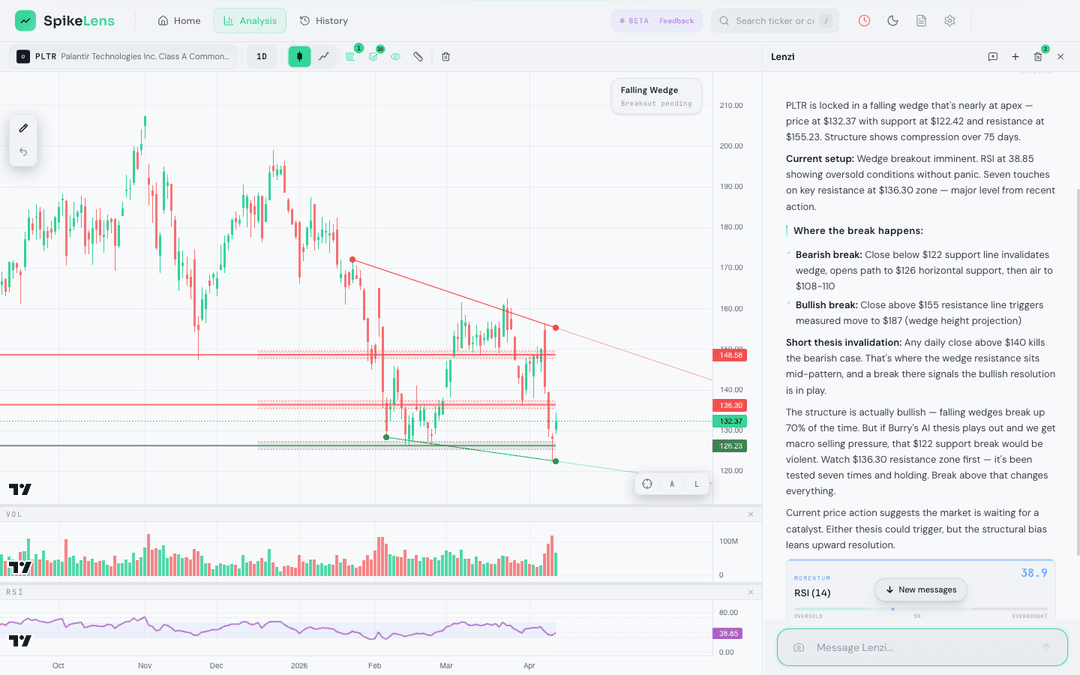
Michael Burry just publicly bet against Palantir — thesis: Anthropic is a serious threat to PLTR's AI business, could drop 60%. Chart says that's one of two paths. PLTR is in a 75-day falling wedge, price near $132, wedge support at $122.42 and resistance at $155.23. Short dies on any daily close above $140.
Market Summary
Current price: $132.37 Structure: 75-day falling wedge, near apex — breakout pending Pattern status: Compression over ~3 months RSI: 38.9 (oversold-without-panic, momentum falling) Catalyst: Burry's short thesis publicly disclosed — "Anthropic is a serious threat" Context: PLTR up ~1,400% through the AI boom cycle; first named short from a high-profile investor
The Detail
Palantir has been in compression for about 75 trading days — a textbook falling wedge forming after the post-AI-boom parabolic phase. The shape of the pattern is structurally bullish: lower lows are getting *shallower* and converging toward a rising-support trendline, while lower highs are also weakening. That's compression before a resolution.
Burry's thesis lives in the macro layer: if Anthropic eats Palantir's enterprise-AI moat, the stock revalues sharply lower. That's a *fundamental* short, not a structural one. The chart doesn't disagree with the possibility — it just shows exactly where the chart would confirm or invalidate it.
RSI at 38.9 is interesting context: oversold-without-panic. That's exactly the condition you'd expect late in a falling wedge — sellers exhausted, not capitulating. It's a statistically favorable moment for buyers to take control, but momentum is still technically falling, which means no confirmation yet.
The key tell is $136.30. This level has held 7 times through the current compression. It sits mid-wedge, between the wedge support at $122 and the wedge resistance at $155. If the pattern resolves upward, $136 is the first level to clear. If it holds as resistance on any attempt, the short thesis gets runway. If it breaks with volume, the bull case gets real oxygen.
Statistical context: Falling wedges break up ~70% of the time. That's the base-rate. Burry's thesis argues the base-rate doesn't apply here because of the specific macro threat. The chart says: if the base-rate is wrong, we'll see it at $122 failing. If the base-rate holds, we'll see it at $155 breaking. No need to guess — both levels are testable.
Newsletter
Stay ahead of the market with SpikeLens.
Daily stocks and market content — structure reads, key levels, and trade scenarios.
What to Watch
- First tell: $136.30 resistance — 7-touch zone, the earliest confirmation signal either way
- Bear-case tell: daily close <$122 with volume expansion
- Bull-case tell: daily close >$140, confirmed by break >$155
- Time window: 2–4 weeks — falling wedges at apex typically resolve within a month
Bottom Line
Burry's thesis isn't wrong as a scenario — but it's one of two paths. The chart defines both with specific price levels. Short dies on a close above $140. Wedge statistics favor upward resolution ~70% of the time, but the base-rate doesn't account for named macro threats. Watch $136 first — that's where the story starts telling itself.
Key Levels